Position / Product concept, hardware development, integration, and field testing
Position prototype development: from idea to field testing.
Position is an ongoing product development project for event intelligence. It brings together location data, radio communication, and event software to explore a clearer view of what is happening on a course, even out of sight.
My role: Product concept, prototype integration, interface development, and iterative testing
Project status: Ongoing prototype development

Concept illustration of the intended experience. Position is in active development.
The challenge: information beyond a location dot
Knowing where a competitor is can be useful, but event staff also need context. Is a unit still reporting? Has it stopped moving? Is the information recent enough to act on? Position is being developed around those practical questions.
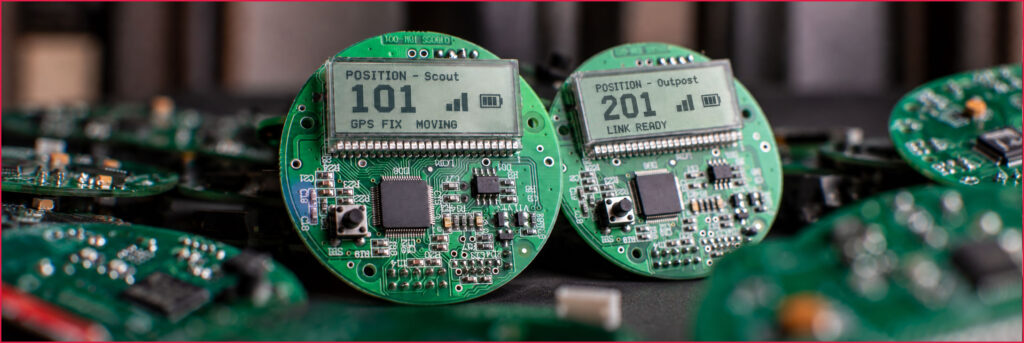
The concept uses Scout units, Outposts, and a Base to explore local communication across a course. The aim is to support event awareness in places where cellular coverage may be limited.
My contribution: connecting the pieces
I am developing the product concept and working across hardware integration, device displays, enclosure design, software interfaces, and test workflows. The challenge is making those pieces work together in a way an event operator can understand.
Testing has included stationary checks, walking tests, relay experiments, and shared-radio load tests. Those sessions expose questions about reception, reporting delays, device states, and recovery after missed messages. Each revision provides another opportunity to measure what changed.
Build enough to test the important questions, then let the evidence guide the next revision.
.
The result so far: a working development platform
Position remains an active prototype project. Working units and test software provide a way to examine the concept in real conditions, identify limitations, and refine the next version.
The value of this stage is the learning. A display can look clear at a desk and raise new questions outside. A communication link can work nearby and behave differently around trees or terrain. Prototyping turns those assumptions into specific questions that can be tested.
Have an idea that needs a practical first prototype?
Tell me what you are building and where you need help.